
Ask ten companies working at height for the inspection record on a specific harness — serial number, last twelve months — and you will get ten different answers. A few produce it in a minute. Most produce something eventually. Some produce a logbook with a gap where a technician left the company.
The inspection itself is rarely the problem. Crews check their kit. What goes missing is the evidence that they did.
Two kinds of inspection, two kinds of record
Pre-use checks happen every time the kit comes out. Fast, hands-on, done by the person about to hang on it. Most jurisdictions expect these to happen and do not expect a form for every single one — but on a job with a documented pre-work process, recording them is the difference between “we always check” and “here is the check from that morning.”
Periodic or detailed inspections are the scheduled ones, done by a competent person, item by item, with a result recorded against each item. These are the records people come looking for, and the ones that need to survive staff turnover.
What belongs in the record
For each item:
- Identity. Make, model, serial or unique ID. “Harness 4” means nothing once there are three Harness 4s across two vans.
- Date in service. Not the purchase date — the date it started being used. Manufacturer service life usually runs from first use.
- Inspection date and who did it. A name, not “crew.”
- What was checked. The points you actually looked at: webbing, stitching, hardware, sheath, core, action of the moving parts.
- The result. Pass, monitor, or remove from service. “Monitor” is only useful if it says what to watch and when to look again.
- What happened next. If it failed, what was done with it. A record that ends at “failed” leaves an auditor asking whether it went back in the van.
For the kit as a whole: what is in service, what is quarantined, and what has been destroyed. Destroyed matters — kit that fails inspection and then reappears is the failure mode that ends badly.
The gap most companies have
The paper trail usually breaks in the same two places.
The first is the truck. An inspection gets done on site and written on whatever is nearby, to be entered properly later. Later is busy. The note goes through the wash.
The second is the handover. A technician leaves, and their logbook goes with them, or their inspections were recorded against initials nobody can now identify.
Recording the inspection where it happens, against a company record rather than a personal one, fixes both. It is not more rigorous — it is just the same rigour that survives a resignation.
How long to keep it
Retention rules vary by jurisdiction and by the kind of record, so check what applies where you work rather than adopting a number you read once. Practical guidance that holds up in most places:
- Keep an item’s full inspection history for as long as the item is in service, plus the period your regulator sets for records of that kind.
- Keep the record of removal from service longer than the item itself. If something is ever questioned after an incident, this is the document that matters.
- Keep training and certification records for each worker while they are employed and for the retention period that applies afterwards.
Our requirements finder lists what each jurisdiction asks you to document and retain, with the citation, so you can set a policy against the actual rule instead of a habit.
Certifications are the other half
An inspection record proves the kit was fit to use. A certification record proves the person was. Both get asked for at the same moment, usually by the same client, usually on a Friday.
The failure here is quiet: a ticket expires, nobody notices, and the crew keeps working. It is not discovered until someone checks — often during an audit, occasionally after an incident. Tracking expiry dates against each worker, with a warning before the date rather than after, turns that into a non-event.
What this looks like in RopeDocs
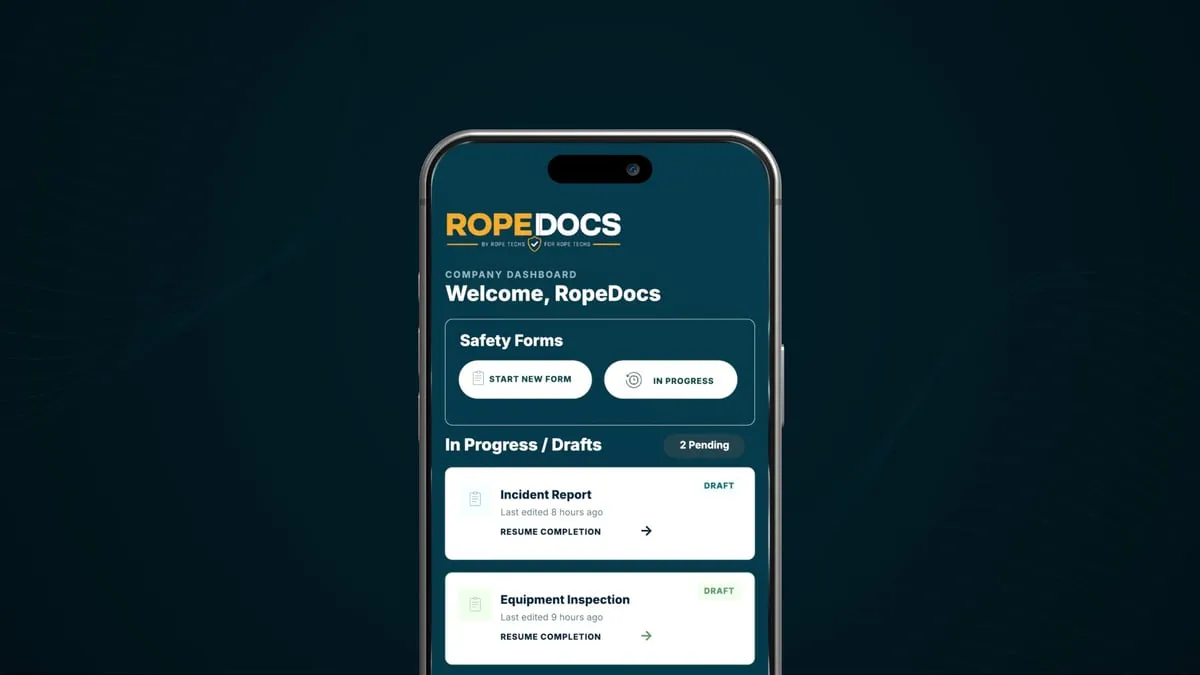
Equipment inspections are one of the form types in the app, so the inspection gets recorded at the job on a phone, offline if there is no signal, and syncs when there is. Each completed inspection becomes a PDF with your logo on it, stored against your company account, so producing “the record for that harness” is a search rather than an excavation.
Employee records hold each worker’s training and certifications with their expiry dates, and RopeDocs warns you before a ticket lapses.
None of that makes a company compliant on its own — the work still has to be done properly by competent people. What it does is make the records exist, stay together, and be findable when somebody asks. See what it costs, or read the rescue plan checklist next.